Motorcycle route along the Pilica River: from Warka to the Sulejów Reservoir
30/06/2026
⛽
Track Your Fuel Costs
Log every fill-up, monitor consumption trends and keep all your motorcycle expenses in one place — powered by AI.
Start Your Fuel Journal →Mazovia and Łódzkie have a reputation for being flat and boring. Fields, straight roads, nothing to get your blood pumping. And that’s partly true — if you ride here on the S7 expressway or the “seven” with your head somewhere else.
Table of Contents
- 1. The Pilica route in a nutshell
- 2. Why it’s worth riding the Pilica valley by motorcycle
- 3. Route step by step: from Warka to the Sulejów Reservoir
- 3.1. Start in Warka — Pułaski, the brewery and first contact with the river
- 3.2. Białobrzegi and Nowe Miasto nad Pilicą
- 3.3. Inowłódz — Romanesque church and castle ruins
- 3.4. Spała and the Spalskie Forests — the forest chapter of the route
- 3.5. Konewka — concrete bunkers in the forest
- 3.6. Tomaszów Mazowiecki — Niebieskie Źródła and Nagórzyckie Caves
- 3.7. Sulejów and the Cistercian abbey — the finish by the reservoir
- 4. Sulejów Reservoir — what to do at the finish
- 5. Practical tips: fuel, food, accommodation
- 6. When to go and what to watch out for
- 7. Route variants: shortening and return loop
- 8. Summary — a calm route with character
But there is a river that cuts diagonally across this region and drags along one of the most pleasant routes for a one-day trip from around Warsaw or Radom. The Pilica. Narrow, winding, wild as for a lowland river, with valleys, pine forests and small towns where time has slowed down a bit.
This route runs along it, from Warka to the Sulejów Reservoir. This is not a ride on hairpins — I’ll say it straight away so you don’t count on mountain passes. It’s a ride for those who like calm, scenic roads, sensible distances and attractions that are really worth getting off the bike for. Perfect for a first more serious trip, a ride for two, or a lazy Sunday when you don’t feel like torturing yourself with eight hours in the saddle.
In this guide I break the route down into parts: where to ride, what to see along the way, where to refuel and eat, when to set off and what to watch out for. No sugar-coating, just specifics.
The Pilica route in a nutshell
Before we get into details, here are some numbers so you know what you’re signing up for.
- Start: Warka (Mazowieckie voivodeship, about an hour’s ride from Warsaw)
- Finish: Sulejów Reservoir / Sulejów (Łódzkie voivodeship)
- Distance: realistically 130–160 km one way, depending on how closely you stick to the river and how many loops you add along the way
- Riding time: about 3–4 hours net, but with stops plan for the whole day
- Surface: mostly good asphalt on regional and local roads, with some patches and narrow sections
- Character: lowland, calm, scenic — forests, river valley, small towns
- For whom: asphalt tourer, moto-couple, new rider, anyone looking for a weekend reset
It’s a route you can easily do in one day. But if you want to experience it rather than just blast through it, stay overnight by the reservoir and come back the next day via a different road. I describe variants at the end.
Why it’s worth riding the Pilica valley by motorcycle
Honestly: if I were looking for adrenaline, I wouldn’t come here. The Pilica flows through lowlands, so you won’t find “tear-inducing” corners here. But this route plays a different game.
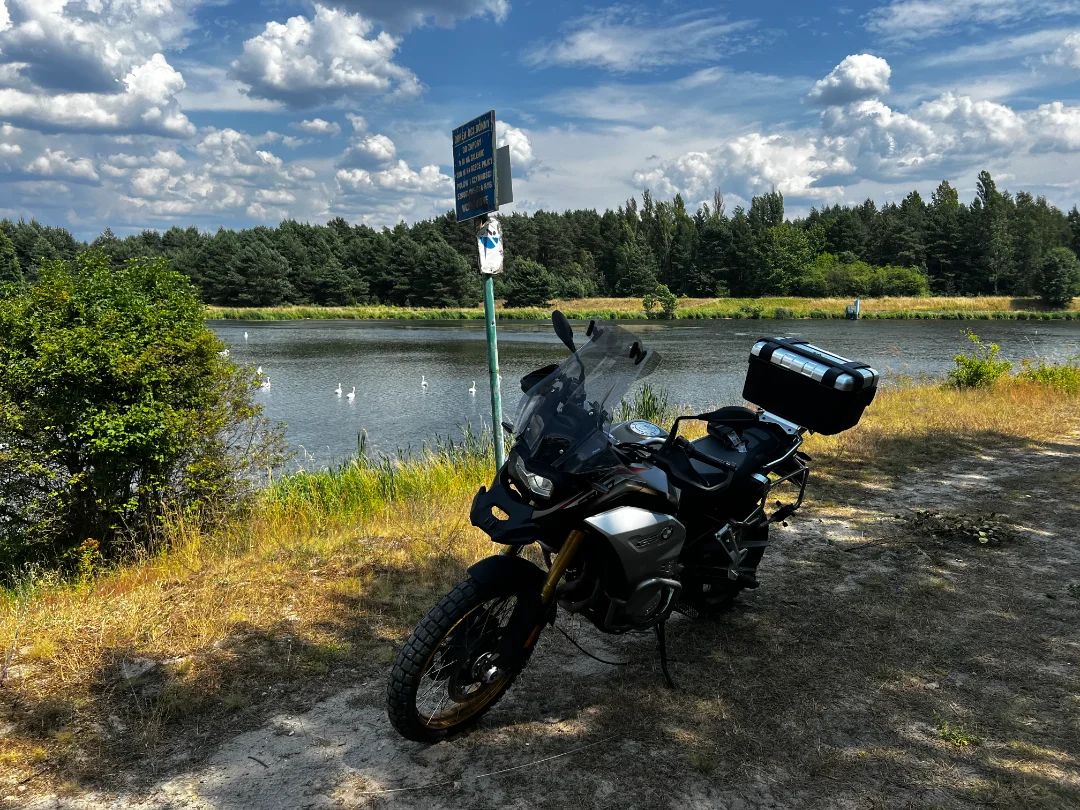
First — nature. The Pilica is one of the cleanest and most natural lowland rivers in Poland. It meanders, forming bends, oxbows and sandy bars. One moment you ride through fields, the next you enter a pine forest that smells of resin through your helmet. The Spalskie Forests at the end of the route are a real breath of fresh air.
Second — traffic. Apart from weekend crowds by the reservoir, the roads along the river are quiet. You can ride at your own pace, without a queue of trucks on your tail.
Third — concrete things to see. The Romanesque church in Inowłódz, the ruins of Casimir the Great’s castle, presidential Spała, concrete bunkers in the forest near Konewka, the Cistercian abbey in Sulejów. On one route you get the Middle Ages, the interwar period and World War II. This is not riding for the sake of riding — it’s a trip with a storyline.
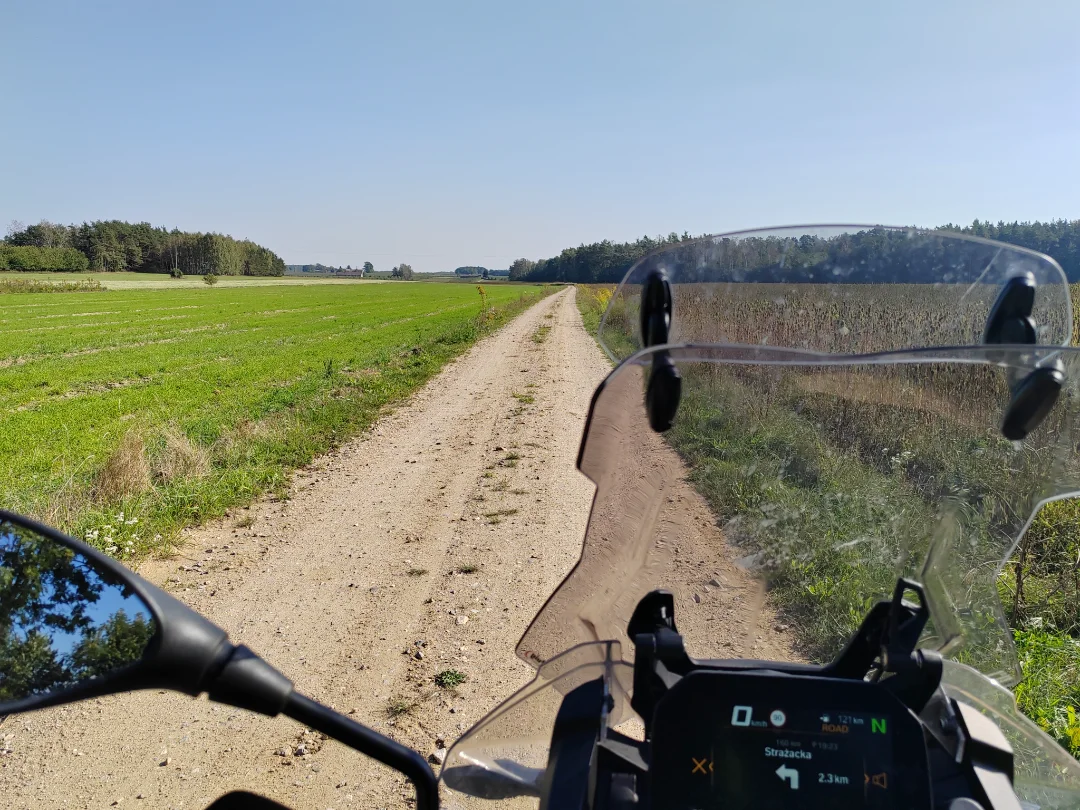
Do you ride an adventure bike and dream of gravel? This isn’t exactly paradise, although you’ll find forest tracks near the Pilica if you leave the main roads. But the essence of this route is calm asphalt.
Route step by step: from Warka to the Sulejów Reservoir
Start in Warka — Pułaski, the brewery and first contact with the river
Warka is a good place to start because it’s easy to get here from Warsaw or Radom, and the town itself has its own vibe. Most people associate it with beer, and rightly so — the Warka brand comes from here. But the real highlight on the map is the Kazimierz Pułaski Museum in nearby Winiary, housed in a classicist manor with a park. Pułaski, a hero of two continents, was born in these parts. Even if history usually bores you, the park on the Pilica escarpment is simply pretty and gives you the first solid view of the river valley.
Fill up to the brim in Warka. There are stations further on too, but it’s smarter to start with a full tank than to improvise later.
Białobrzegi and Nowe Miasto nad Pilicą
From Warka you head upstream, to the southwest. Stick to the roads closer to the Pilica, not the expressway — that’s the whole point.
Białobrzegi is more of a technical stop: fuel, coffee, a simple lunch. The town lies right on the river, so it’s a good moment for the first longer break and to stretch your legs by the water.
Nowe Miasto nad Pilicą is more interesting. An atmospheric market square, a slow pace and again the river right next door. It’s a typical example of a small town where there are no capital-A “Attractions”, but there is an atmosphere that makes it worth slowing down. From here it gets greener — you’re entering an area where forest starts to dominate over fields.
Inowłódz — Romanesque church and castle ruins
This is one of the strongest points of the entire route and, in my opinion, the moment when the Pilica valley shows what it can do.
In Inowłódz stands the Church of Saint Giles — a small Romanesque sandstone church, one of the oldest in this part of Poland. Austere, stone, completely different from what you usually pass by the road. And a bit further on you have the ruins of Casimir the Great’s castle, built to guard the river crossing. You ride up a hill, park, walk along the walls and look at the Pilica from above. Really worth it.
Inowłódz is also a good place for lunch. The river is wide and picturesque here, and there are places to sit.
Spała and the Spalskie Forests — the forest chapter of the route
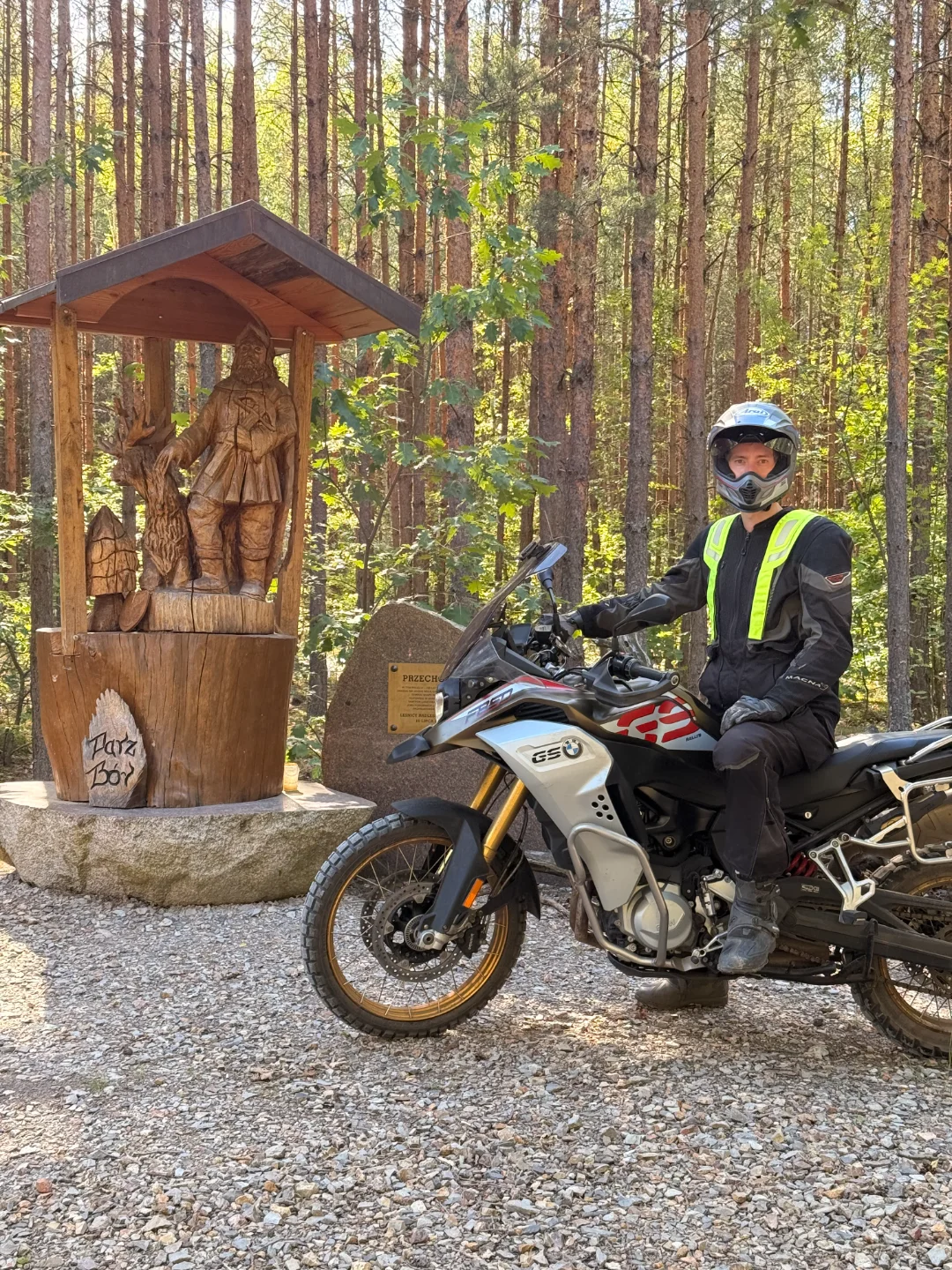
Past Inowłódz you enter the Spalskie Forests and here the route changes character. Pine forest on both sides, the road running through a green tunnel, shade and the smell of resin. After open lowland terrain it’s a pleasant change.
Spała has an interesting history. First it was a tsarist hunting residence, then a summer seat of the presidents of the Second Polish Republic. You can still feel this “presidential” touch — in the layout of the village, in the bison monument, in the atmosphere of a forest resort. It’s a natural place for a longer stop: coffee, a walk, catching your breath before the final stretch.
Konewka — concrete bunkers in the forest
A bit past Spała, in the forest near Konewka, hides something you wouldn’t expect: a huge reinforced concrete railway bunker from World War II. The Germans built it to hide an entire staff train. Today it’s an open attraction you can visit. Standing inside this concrete hall makes an impression — especially the contrast with the idyllic forest around. If you like military history or just unusual places, plan a stop here.
Tomaszów Mazowiecki — Niebieskie Źródła and Nagórzyckie Caves
Closer to the reservoir lies Tomaszów Mazowiecki. The town itself is industrial, but it has two things worth detouring for.
Niebieskie Źródła (Blue Springs) is a nature reserve with karst springs where the water can take on an incredible blue-turquoise hue. A short walk, and the view sticks in your mind. The second highlight is the Nagórzyckie Caves — man-made underground corridors carved into sandstone, cool even on a hot day. Perfect when July heat is getting to you in motorcycle gear.
In Tomaszów you’ll also find the Pilica River Open-Air Museum if you want to round off the river theme, and near Smardzewice a bison breeding centre — an interesting stop especially if you’re riding with kids or as a couple.
Sulejów and the Cistercian abbey — the finish by the reservoir
The finale of the route is Sulejów and, in its part called Podklasztorze, the Cistercian abbey. It’s one of the best-preserved Romanesque-Gothic complexes in Poland, with thick defensive walls and towers. The stone abbey church can hold even someone who “just wants a quick look” for longer. A good closing accent — the Middle Ages on the shore of the reservoir.
And right next to it you already have the water.
Sulejów Reservoir — what to do at the finish
The Sulejów Reservoir was created by damming the Pilica and is a sizeable body of water surrounded by forests. It’s a natural finish and a place where it’s worth staying longer than just for a souvenir photo.
After a whole day in the saddle you have several options here. Beaches and swimming areas if you hit hot weather — the water is tempting after hours in full gear. Fish shacks and waterfront places where you can eat something hot with a view. Towns like Smardzewice or Zarzęcin are typical bases with accommodation, resorts and campsites.
If you plan to stay overnight, that’s a good idea. In the morning, when mist rises from the reservoir and tourists are still asleep, you have the place more or less to yourself. And it’s worth coming back for.
Practical tips: fuel, food, accommodation
Fuel. Larger towns on the route — Warka, Białobrzegi, Nowe Miasto nad Pilicą, Tomaszów Mazowiecki, Sulejów — have petrol stations. On the forest sections around Spała it can be empty, so don’t run below reserve. The rule is simple: you see a station, you have less than half a tank, you’re before a forest — fill up.
Food. It makes the most sense to plan lunch in Inowłódz, Spała or right by the reservoir. Spała has plenty of places thanks to its tourist character. By the reservoir, go for fish shacks — that’s the local classic. Along the way, in smaller towns, you’ll find simple bars and bakeries for a quick coffee and a bite.
Accommodation. If you’re turning this into a two-day trip, the densest accommodation base is around the Sulejów Reservoir and in Spała. Guesthouses, resorts, rooms, campsites — the full range. In peak season, July and August, book ahead, because it gets crowded by the water, especially on weekends. Look for a place with secure parking or shelter for the bike.
When to go and what to watch out for
The best time is from May to September. Spring on the Pilica is lush green, autumn can show the golden Spalskie Forests in full glory. July and August are the warmest but also the busiest — on hot weekends the reservoir area turns into one big car park. If you can, go during the week or outside peak season.
A few practical things to watch out for:
- Road surface. Local roads can surprise you with patches and potholes, especially on the shoulders. After rain, forest sections can be slippery from sand washed onto the asphalt.
- Sand and leaves. This is an area of forests and fields — sand tends to collect on shaded corners. Read the road ahead of you.
- Wild animals. The Spalskie Forests are an area where deer or wild boar by the roadside are nothing unusual. At dawn and dusk, ride with your head screwed on.
- Weekend traffic by the reservoir. In summer, access roads to the beaches can get jammed. Patience or an earlier hour.
Route variants: shortening and return loop
The route is flexible and easy to adapt to how much time you have.
Only have half a day? Do a shortened section Warka–Inowłódz–Spała and turn back. You get the essence: the river valley, the Romanesque church, castle ruins and forested Spała, without having to do the full distance both ways.
Doing a loop in one day? Towards the Pilica, take the slower roads along the river, and return via faster main roads or the expressway. That way you don’t waste time on the way back, and you catch the highlights on a relaxed ride “outbound”.
Want the full experience? Split the trip into two days with an overnight by the reservoir. Day one: route along the Pilica with all the stops, evening by the water; day two: return via a different road or add a loop in the area. This is the version I recommend if you’re riding as a couple — that’s when this route really opens up.
Summary — a calm route with character
The Pilica valley won’t win you over with mountain twisties. It will win you over with something else: a wild lowland river, pine forests, quiet roads and a concentration of concrete places where you actually want to stop. Romanesque Inowłódz, presidential Spała, concrete bunkers near Konewka, the abbey in Sulejów and the reservoir at the finish — all this fits into one calm day of riding.
It’s an ideal route for a first longer trip, a lazy weekend for two or a reset after a tough week. Remember the essentials: start with a full tank in Warka, stick to the roads closer to the river instead of the expressway, plan lunch in Spała or by the reservoir, and if you can — stay overnight by the water and ride back in the morning.
You have a motorcycle and a free Sunday. The Pilica is waiting just around the corner. Drop a pin on the map and go.
And if you’ve already ridden this route — let me know in the comments which way you went and what you’d add to the list of stops. The best guides are born from such notes.
#Poland#Masovian#Pilica#offroad#river#adventure
Frequently Asked Questions
- How many kilometres is the route from Warka to the Sulejów Reservoir?
- People count it differently, depending on how close to the river you ride and how many loops you add along the way. Realistically it’s 130–160 km one way. Pure riding time will be about 3–4 hours, but with stops in Inowłódz, Spała and Tomaszów you’ll easily fill the whole day.
- Is this a good route for a beginner motorcyclist?
- Yes, it’s one of the better “starter” routes in this part of Poland. Lowland terrain, no sharp hairpins, sensible distances and plenty of places to take a break. You just need to watch out for sand on forest corners and the variable condition of local roads. If you’re coming back to riding after years off, or just getting into it after your licence course, this route will be just right.
- What is worth seeing along the Pilica route?
- The strongest highlights are: the Kazimierz Pułaski Museum in Warka, the Romanesque Church of Saint Giles and castle ruins in Inowłódz, presidential Spała, the wartime railway bunker near Konewka, the Niebieskie Źródła (Blue Springs) and Nagórzyckie Caves near Tomaszów Mazowiecki, and the Cistercian abbey in Sulejów. To finish, the Sulejów Reservoir itself with beaches and fish shacks.
- Can this route be done in one day?
- You can, and without rushing. If you set off in the morning, you’ll comfortably ride the whole thing with several stops and get back in the evening via a faster road. But if you really want to explore Spała, the reservoir and the abbey, it’s better to split the trip into two days with an overnight stay by the water.
- When is the best time to ride a motorcycle to the Sulejów Reservoir?
- The season basically runs from May to September. Spring and early autumn give the nicest views and lighter traffic. July and August are the warmest, but the reservoir area can be crowded then, especially on weekends. If you have a choice, aim for a weekday or outside the peak holiday period.
Check other routes
Iceland and the Faroe Islands by Motorbike: How to Plan and Ride the North Atlantic's Best Loop
Alpine Bends, Espresso and Moto Guzzi. A Complete Scenario for the Italian Trip of a Lifetime

Beijing at Full Throttle: 8 Places You Must Visit in the Chinese Metropolis
Top 5 Off-Road Routes to Ride in the Alps (with Tips for Adventure Motorcyclists)

Ducati #WeRideAsOne 2026: One Global Parade on May 9 to Celebrate 100 Years of Passion