XPENG P7+ – our verdict after a week behind the wheel
09/10/2026
⛽
Track Your Fuel Costs
Log every fill-up, monitor consumption trends and keep all your motorcycle expenses in one place — powered by AI.
Start Your Fuel Journal →A week with the XPENG P7+ in the garage and on everyday runs – commuting, shopping and parking in a tight city – was enough to form a clear opinion on the RWD Long Range Pro. This is not a polite, middle-of-the-road review: where it impressed us, we say so plainly; where it frustrated us, we do not gloss over it either.
Table of Contents
- 1. First problem: this car is enormous
- 2. What sort of car is it?
- 3. Technical data
- 4. Price and what you get for it
- 5. Price against the competition
- 6. Driving impressions – ours, not the brochure’s
- 7. Interior and infotainment
- 8. Space, boot and towbar
- 9. Range and charging in the real world
- 10. Pros and cons
- 11. Who is the XPENG P7+ for?
First problem: this car is enormous
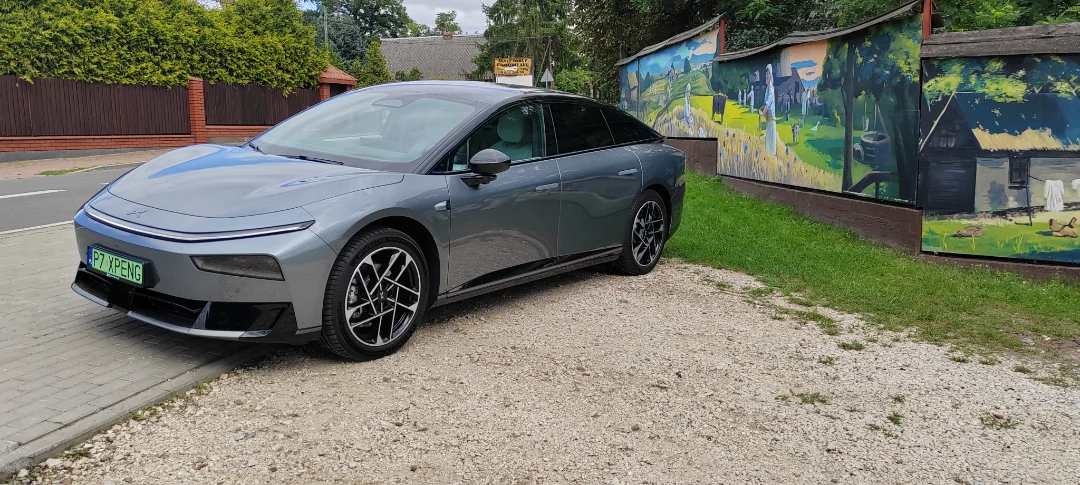
Before we could judge the infotainment or range, we ran into a purely physical issue. The XPENG P7+ is 5,071mm long and 1,937mm wide, so in practice it fills an entire parking bay lengthways – both in a home garage and when parking in town. We normally keep a motorcycle behind the car in our garage, which is a layout we are used to. With the XPENG P7+, it simply did not work. The car took up the full length of the space, leaving nowhere to put the bike behind it.
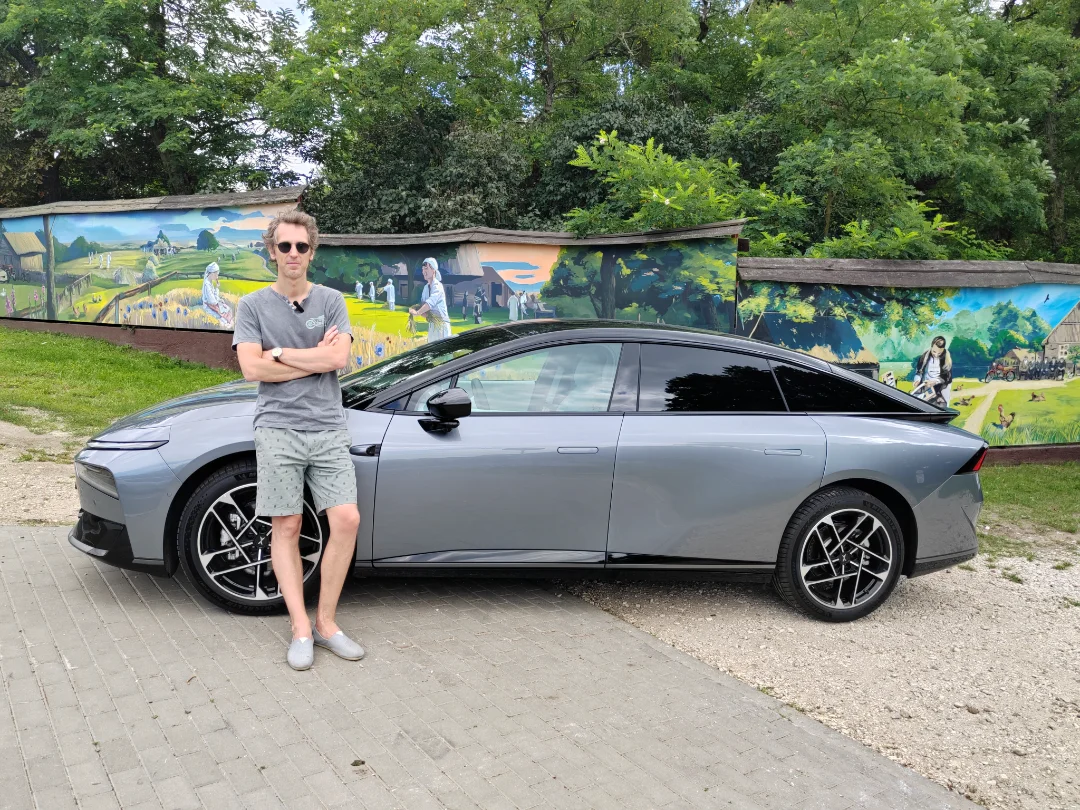
That is not a minor detail: it is a genuine usability issue for anyone who, like us, shares a garage between a car and a motorcycle. If you have a standard parking space or a garage designed around a conventional D- or E-segment saloon, measure it before arranging a test drive.
What sort of car is it?
At first glance, the P7+ looks like a sleek saloon. In reality, it is a fastback: the entire tailgate lifts together with the rear screen, making the boot easier to access than that of a conventional saloon. With the rear seats folded, its 1,931-litre capacity feels closer to that of a large estate car than a four-door saloon.
Behind it is Chinese manufacturer XPENG, one of the companies currently setting the pace in premium electric cars. The European-spec car is assembled at Magna Steyr’s plant in Graz, Austria. European assembly is a tangible advantage: a shorter supply chain and a potentially meaningful effect on pricing.
The P7+ has already made a dynamic UK appearance at the Goodwood Festival of Speed. However, at the time of writing, XPENG has not confirmed UK retail availability, right-hand-drive specification, pricing or an order timetable for the P7+. That means prospective British buyers should treat all European trim and price information as provisional until a UK specification is announced.
Technical data
The P7+ is offered in three versions in European markets. We drove the middle model: the RWD Long Range Pro.
Specification | RWD Standard Range Pro | RWD Long Range Pro (our test car) | AWD Performance Pro |
|---|---|---|---|
Drive | rear-wheel drive | rear-wheel drive | all-wheel drive |
Power | approx. 245hp | approx. 313hp | approx. 503hp |
0–62mph | 6.9sec | 6.2sec | 5.1sec |
Battery (LFP) | approx. 61.7kWh | approx. 74.9kWh | approx. 74.9kWh |
WLTP range | 455km / 283 miles | 530km / 329 miles | 500km / 311 miles |
Energy use (WLTP) | 15.2kWh/100km | 16.4kWh/100km | 17.4kWh/100km |
DC charging power | 350kW | 446kW | 446kW |
10–80% charging | approx. 12 minutes | approx. 12 minutes | approx. 12 minutes |
Kerb weight | 2,024kg | 2,125kg | 2,225kg |
Common to all versions are a 3,000mm wheelbase, dimensions of 5,071 × 1,937 × 1,512mm, five seats, a 573–1,931-litre boot and an optional electrically retractable towbar rated to tow up to 1.5 tonnes.
Price and what you get for it
There is no confirmed UK price for the RWD Long Range Pro at present, so it would be misleading to convert continental prices into pounds and call that a British list price. What we can say is that the European specification includes equipment that is far from routine in this class: an 800V electrical architecture with DC charging at up to 446kW, Nappa leather, massaging seats in all four outer positions and an infotainment system which, apart from one important caveat covered below, works very well.
Until XPENG publishes a UK price list and standard equipment details, any direct value comparison with British-market alternatives should be treated with caution. On specification alone, though, the P7+ clearly aims to offer a great deal of luxury and technology rather than merely chase a headline price.
Price against the competition
Because the P7+ is not yet confirmed for UK retail sale, there is currently no fair like-for-like British price comparison to make. The relevant alternatives are likely to include the Tesla Model 3, BYD Seal and electric executive fastbacks from established European brands, but final comparisons must wait for a UK list price, trim structure and right-hand-drive specification.
On paper, none of those cars is automatically inferior: the key differences will come down to standard equipment, cabin materials, charging capability and how the systems work day to day. Those last points are exactly what we were able to assess during our week with the P7+.
Driving impressions – ours, not the brochure’s
On a straight run, the P7+ is calm and comfortable. Cabin insulation does genuinely impressive work, the electric motors are almost silent and the suspension rounds off poor road surfaces effectively. In corners, though, the steering feels noticeably remote: it is difficult to read what the front axle is doing, so we stopped trying to drive it quickly through bends by the second day. This is not a car for steering-wheel thrills – although there is certainly a hit of excitement when you floor it. It is a car for covering miles in peace.
The default driving position also felt fairly high to us. We got used to it after a few days, but the first impression was slightly SUV-like despite the fastback silhouette.
Interior and infotainment
This is where XPENG really gets into its stride, and where it is clear that the brand is aiming at the premium class rather than simply a comparison-chart victory. Perforated Nappa leather, a cashmere-like headlining, quietness at higher speeds, plus heated, ventilated and massaging seats in all four outer positions: we used the massage function almost every day after longer journeys and quickly became attached to it. This is a comfortable car for long days at the wheel, not merely on paper.
The XOS 5.10 system – with its 15.6-inch central display, 8.8-inch digital instrument screen and head-up display – is smooth and easy to learn. The “Hey XPENG” voice assistant genuinely understands commands. We asked it to open the rear right-hand window, activate massage for a selected seat, adjust the climate control and play a particular playlist, and it worked faultlessly every time.
There is, however, one important caveat: the whole system, including the voice assistant, operates in English only. For UK buyers, that is naturally much less of an issue than it is in non-English-speaking markets, and the English-language operation itself is excellent. Still, buyers should verify the exact software, connected services and voice-control functions fitted to any eventual UK car.
A second small point concerns the head-up display. In the P7+, the HUD currently shows route guidance only from the built-in navigation system, not navigation mirrored from a phone through Apple CarPlay or Android Auto. The built-in navigation itself is genuinely very good: on longer journeys it suggests attractive, interesting roads rather than merely the shortest route. XPENG has also announced a collaboration with Google intended to bring full Google Maps functionality into the system while retaining XPENG’s interface design, which could make phone-based navigation far less necessary.
The final irritation was the shortage of physical controls around the driver. In some other cars we have tested, including the XPENG G9, the seat-adjustment control also provides quick access to the massage function, so it is available without looking at a screen. The P7+ does not have that shortcut. To activate massage, you must either use voice control or work through the on-screen menus. It is a small thing, but after a week it starts to become annoying.
Driver assistance is handled by XPILOT ASSIST3, based on XPENG’s proprietary Turing AI chip architecture, with computing power of up to 750 TOPS. It keeps lane position and following distance BRILLIANTLY, while also supporting parking manoeuvres. It remains a Level 2+ semi-autonomous system rather than full autonomy, however: your hands must stay on the wheel and your eyes on the road.
Space, boot and towbar
The 573- to 1,931-litre boot swallowed our equipment for a full week of testing without complaint, including motorcycle panniers that happened to be close at hand. The 3,000mm wheelbase creates genuinely generous rear legroom.
The optional 1.5-tonne towbar is a serious selling point for anyone hauling a motorcycle trailer. Most light single-axle trailers carrying a touring bike should sit comfortably within that limit. We did not tow a trailer during this test week, so we cannot comment on the real-world impact on range; that is one for a future test.
Range and charging in the real world
The claimed 530km / 329-mile WLTP range of our version translated, in everyday use combining town driving and longer roads without trying to drive economically, into a real-world range of around 400–430km, or roughly 249–267 miles. That is the sort of drop you should expect from any EV outside the laboratory approval cycle.
We were unable to test the headline “10–80% in 12 minutes” claim in real conditions. Achieving it requires a charger capable of delivering up to 446kW, and we simply did not encounter one on our test route. We therefore charged more slowly than the brochure promises. That was not the car’s fault, but a reminder that ultra-high charging capability is only useful when the charging infrastructure can match it.
Pros and cons
Pros:
- Cabin comfort and technology at a level we would not expect at this likely price point
- Very fast DC charging when you find a suitably powerful charger
- Strong real-world range even in normal, unrestrained driving
- Large, practical boot and optional 1.5-tonne towbar
- Excellent cabin refinement and long-distance comfort
Cons:
- Huge dimensions – it used the full length of our garage bay, leaving no room for a motorcycle behind it
- Its maximum charging potential depends on finding exceptionally powerful public charging infrastructure
- No confirmed UK retail price, right-hand-drive specification or ordering timetable at the time of writing
- The HUD does not yet show navigation from Apple CarPlay or Android Auto – only the built-in map
- Too few physical controls around the driver, including no quick shortcut for the massage function
Who is the XPENG P7+ for?
If your budget stretches to a well-equipped D- or E-segment executive car and you value comfort, in-car technology and usable range, our week with the P7+ suggests that it deserves serious consideration rather than being dismissed as simply another Chinese-market curiosity.
There is one sizeable caveat, though: measure your parking space or garage before committing. In our case, the car took up the full length of the bay and our usual “car at the front, motorcycle at the back” arrangement was impossible. If your garage works in a similar way, take that into account before signing anything – once UK ordering and specifications are confirmed.
#xpeng#p7+#ev#Chinese cars
Frequently Asked Questions
- How much will the XPENG P7+ cost in the UK?
- At the time of writing, XPENG has not confirmed a UK retail price, right-hand-drive specification or order timetable for the P7+. Converting European prices into pounds would not be a reliable UK list price.
- What is the XPENG P7+’s range?
- The official WLTP figure is up to 530km, or 329 miles, for the Long Range version. During our week with the RWD Long Range Pro, everyday mixed driving returned around 400–430km, roughly 249–267 miles.
- How long does it take to charge the XPENG P7+?
- XPENG quotes 10–80% in around 12 minutes when using a compatible ultra-high-power DC charger, with up to 446kW charging capability for the Long Range and AWD versions. We could not find a charger powerful enough to test that claim during our week with the car.
- Will the XPENG P7+ fit in a typical garage?
- It may fit lengthways, but in our garage it occupied the full bay and left no room for a motorcycle behind it. At 5,071mm long and 1,937mm wide, it is worth measuring your space before buying or booking a test drive.
- Is the XPENG P7+ available in the UK?
- The P7+ has appeared in the UK, including at the Goodwood Festival of Speed, but UK retail availability, pricing, right-hand-drive specification and delivery dates have not been officially confirmed at the time of writing.
- Does the XPENG P7+ have four-wheel drive?
- Only the AWD Performance Pro version has all-wheel drive. The Standard Range and Long Range versions use rear-wheel drive.
- Where is the XPENG P7+ built?
- European P7+ production and assembly has been completed at Magna Steyr’s facility in Graz, Austria.
- Is the XPENG P7+ infotainment system in English?
- Yes. The system and the “Hey XPENG” voice assistant operate in English, and in our test they worked very well for functions such as windows, seat massage, climate control and music.
- Is the XPENG P7+ navigation good?
- We found the built-in navigation surprisingly good, particularly because it suggested interesting routes rather than only the shortest option on longer journeys. For now, however, the head-up display shows guidance only from the built-in navigation rather than Apple CarPlay or Android Auto.
Check other motorcycle tests
Geely Starray EM-i review: strengths, weaknesses and fuel consumption
Yamaha XSR 125 Legacy – review, verdict and technical specifications
Honda CBR 125 – test, opinions and used-buying guide to a beginner’s sportbike
Kawasaki KLE500: The Return of a Legend or a Reasonable Daily Ride? An Honest Test Without Sugarcoating

Review of the Harley Davidson Pan America 1250 Special - is it worth it?